Found 19 Pulmonary Embolism trials
A listing of Pulmonary Embolism medical research trials actively recruiting patient volunteers. Search for closest city to find more detailed information on a research study in your area.

FLowRetriever for Acute Massive Pulmonary Embolism
To evaluate treatment outcomes of patients diagnosed with high-risk (massive) pulmonary embolism
FLowTriever All-Comer Registry for Patient Safety and Hemodynamics (FLASH)
The FlowTriever Retireval/Aspiration System (referred to as “FlowTriever”) is designed to treat pulmonary embolism (PE) in your lung by removing blood clots from blood vessels. A PE is a blood clot trapped in your lung. The FlowTriever is used to trap the clot and pull it into a catheter so …

A Safety and Feasibility Single-Arm Study of a Novel Catheter Thrombectomy Device For the Treatment of Pulmonary Embolism (ENGULF)
Please see section 4 of the full protocol Please see section 4 of the full protocol Please see section 4 of the full protocol

Evaluation of Vascular Health Profile in Predicting Venous Thromboembolism
The main goal of this study is to utilize previously validated cytometric markers of to identify cancer patients at high risk of VTE. The primary outcome will be DVT or pulmonary embolism (PE). Patients with pancreatic and brain cancer will be enrolled as these patients are known to have higher …

Chronic insomnia and CSF markers of dementia
The purpose of this study is to identify the relationship between chronic sleep disturbance and proteins in spinal fluid that are related to dementia and a molecule called orexin that helps regulate wakefulness and appetite in the brain. Individuals with sleep problems and good sleepers will be asked to participate.

The Diaphragmatic Initiated Ventilatory Assist (Diva) Trial
DIVA is a pragmatic randomized clinical trial (RCT) to determine: among (P) preterm infants born 24-27 6/7 weeks gestation undergoing extubation from mechanical ventilation, whether (I) Non-invasive neurally adjusted ventilatory assist (NIV-NAVA) (C) compared with Non-synchronized nasal intermittent positive pressure ventilation (NS-NIPPV), will reduce the incidence of (O) extubation failure …

Autism Spectrum Program of Excellence
The goal of the ASPE study is to investigate the genetic basis of Autism spectrum disorder (ASD) and autism-related traits.Individuals 3 years old or older with a diagnosis (or suspected diagnosis) of autism spectrum disorder without intellectual disability may be eligible to participate. We are also recruiting individuals with a deletion or …

Gene Transfer for Patients With Sickle Cell Disease Using a Gamma Globin Lentivirus Vector
This Phase 1/2 study will use a novel therapy, ARU-1801, for Sickle Cell Disease, using gene transfer of recombinant -globin lentivirus (LV) vector. The purpose of this study, which involves research, is to determine whether an experimental procedure called “gene transfer” is safe and effective. If you are interested in …
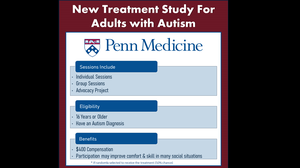
Social Functioning in Adult Autism
This project will test the effectiveness of a new program to improve social functioning in adults with autism spectrum disorder (ASD).
1 - 10 of 19
- 1
- 2
Please choose between Voice or SMS based delivery of verification code

or